
|
Sam Eldin's AI Tailored Virtual Butler Project©
Quick Requirement |
|---|
|
Sam Eldin's AI Tailored Virtual Butler Project - Quick Requirement Table of Contents: • Introduction • Executive Summary • Project Scope • Stakeholders & Resources • Requirements Breakdown • Timelines & Costs • Business Requirements • Functional Requirements • Non-Functional Requirements • Data Requirements • AI/ML Requirements • Technical Requirements • Security Requirements • Performance Requirements • Deployment Requirements • Testing Requirements • Monitoring & Maintenance • Production Introduction: A Requirement Template is a standardized document used to define a project's goals, scope, and technical or business specifications. It ensures all stakeholders align on expectations. It typically includes project overviews, constraints, functional requirements, and non-functional requirements to ensure successful project execution. In this page, we are presenting a Quick Requirement documentation as part of Our Project AI Automation and Intelligence Roadmap. To keep all our audience (technical and non-technical) in the same page and we are trying to simplify the project requirement document to be short and quick. Standard Research Disclaimer: Some of the definitions provided in our documents are based on internet research (including AI websites) conducted in Year 2026. While we strive to ensure the accuracy and reliability of the data, it is provided "as is" without warranties of any kind. This information is for general informational purposes only and should not be treated as professional advice. Users should independently verify any facts, figures, or conclusions before making decisions based on this research. Executive Summary Project Overview: The global aging population is growing rapidly, with the U.S. population aged 65+ projected to reach 82 million by 2050. Alongside this growth comes a rise in cognitive decline, chronic health conditions, social isolation, scam victims and increasing caregiving shortages. Many older adults struggle not only with physical limitations, but with memory, decision-making, and maintaining independence in daily life. These challenges often lead to missed medications, unmanaged finances, reduced quality of life, and increased reliance on caregivers. These elderly are facing chronic health conditions and cognitive decline such as: • Dementia • Alzheimer's disease • General age-related memory decline So, the problem is very real and the aging population is growing fast globally. Business Objectives: Our AI Tailored Virtual Butler Project: Our AI Tailored Virtual Butler Project is one of the answers in helping the elderly with cognitive challenges. In short, our AI Tailored Virtual Butler would be helping elderly with every day task including elders' finances, physical security and physical training. Our AI Tailored Virtual Butler Project would be the AI-powered cognitive support system that acts as a real-time memory, decision assistant, and daily guide for older adults-while keeping caregivers in the loop. Our AI Tailored Virtual Butler Project Return on Investment: Our AI Tailored Virtual Butler Project would greatly reduce the impact on society, government and families. our AI Tailored Virtual Butler Project would help structure and support elders. It would reduce elder supports and dependencies which in turn, it would have a lot less impact on society, government, families and the elders themselves. Actual Saving in Term of Dollars for Government, Families and Caregivers: We need a single and clean total dollar figure, for the actual saving in term dollars for government, families and caregivers when elders use our AI Virtual Butler to help them with every day task including elders' finances, physical security and physical training. To get the actual single and clear total dollar figure we asked; Total Savings if we do the math: ChatGPT - USA : 62 million • Low case: $15B/year * 62 = $930B/year ________________________________________ Google - USA : 62 million $238,000 per elder * 62 million = $14,756B/year The calculated totals are kind of high; we believe the total saving is over $400 Billion per year. Target Audience/Users: Age Grouping According to Health: What is the meaning of age grouping? Age groups refer to distinct classifications of individuals within a population based on their age, often represented in models of population growth that illustrate the proportion of individuals in each age class. In health contexts, age grouping means dividing people into categories based on their age so that health data, risks, and needs can be better understood and managed. It's commonly used in public health, epidemiology, and clinical care. Common Health Age Groups: 1. Infants: 0 - 1 year 2. Children: 1 - 12 years 3. Adolescents: 13 - 18 years 4. Young adults: 19 - 39 years 5. Middle-aged adults: 40 - 64 years 6. Older adults (elderly): 65+ years The focus here is on the elderly 65+ group, plus our AI Tailored Virtual Butler can also be customized or AI Tailored for other Health Age Groups. Project Scope In-Scope: Specific features, deliverables, and tasks included. Specific Features: 1. Cognitive Support (CORE PRODUCT) 2. Task Execution & Guidance 3. Emotional & Social Support 4. Health & Wellness 5. Financial & Life Management 6. High liability 7. Engagement and Growth 8. Personalization Engine - System should learn: 9. Trust & Safety Layer Elderly users are vulnerable to: 10. Liability Section Deliverables: Running AI Virtual Butler on PC, Mobile and tablets with live communication with family members and Caregiver professionals. Tasks Included: Our AI Tailored Virtual Butler Project would build a Virtual AI system which would replace many of the needed help-support and in turn reduces the cost of helping elders by governments, families and caregivers as follows:
Out-of-Scope: Items explicitly excluded to prevent scope creep. See our AI Tailored Virtual Butler Project page for more details: Stakeholders & Resources At this point in architecting-designing, it is too early in the game. • Roles & Responsibilities: List project sponsors, project managers, and the core team. • Resource Constraints: Budget, hardware/software, and staffing limitations. See our AI Tailored Virtual Butler Project page for more details: Requirements Breakdown Functional Requirements: What must the system do? Our AI Tailored Virtual Butler would be helping elderly with every day task including elders' finances, physical security and physical training. Our AI Tailored Virtual Butler Project would be the AI-powered cognitive support system that acts as a real-time memory, decision assistant, and daily guide for older adults-while keeping caregivers in the loop. At its core, it blends automation, organization, and conversational intelligence to assist with matters such as: • Scheduling and calendar management • Sending messages or coordinating communications • Retrieving information or preparing summaries • Managing reminders, tasks, and daily logistics In short: An AI Virtual Butler is a personal assistant with a memory, a mind for efficiency, and-if properly designed-a touch of charm. Functional Requirements: System qualities: Our AI Virtual Butler would be running on PCs, mobiles and tablets or any electronic device. It would be cloud-based and provides all cloud security, compliance, performance, availability and intuitive and easy to use by elders. Timelines & Costs Deadlines: Would be provided soon. Cost-Benefit Analysis: Expected project costs versus the projected return on investment (ROI). Our AI Tailored Virtual Butler Project Return on Investment: Our AI Tailored Virtual Butler Project would greatly reduce the impact on society, government and families. our AI Tailored Virtual Butler Project would help structure and support elders. It would reduce elder supports and dependencies which in turn, it would have a lot less impact on society, government, families and the elders themselves. Actual Saving in Term of Dollars for Government, Families and Caregivers: We believe the total saving is over $400 Billion per year. Business Requirements Define the problem to solve: In 2026, the total population of adults aged 65 and older in the United States is approximately 62 to 66 million. This demographic accounts for nearly 18% to 19% of the nation's overall population, representing the largest sustained surge of aging Americans in U.S. history. Globally, there are approximately 850 to 860 million people aged 65 and older. This demographic accounts for roughly 10.5% of the total world population, reflecting a historic shift in human demographics due to increased life expectancy and declining fertility rates. These elderly are face chronic health conditions and cognitive decline such as: • Dementia • Alzheimer's disease • General age-related memory decline So, the problem is very real and the aging population is growing fast globally. Identify target users - aged 65+: The global aging population is growing rapidly, with the U.S. population aged 65+ projected to reach 82 million by 2050. Alongside this growth comes a rise in cognitive decline, chronic health conditions, social isolation, scam victims and increasing caregiving shortages. Many older adults struggle not only with physical limitations, but with memory, decision-making, and maintaining independence in daily life. These challenges often lead to missed medications, unmanaged finances, reduced quality of life, and increased reliance on caregivers. Establish Success Metrics (accuracy, revenue impact, time saved, etc.): An aging population, driven by longer life expectancies and lower birth rates, significantly strains society, governments, and families by increasing demand for healthcare and social support while reducing the working-age tax base. By 2030, in the U.S., those over 65 will outnumber those under 18, putting immense pressure on federal budgets, social security, and medical systems. Determine Project Scope and Constraints: A Project AI Automation and Intelligence Roadmap is the sequence of processes of deployment of artificial intelligence to optimize, visualize, and automate complex workflows. It pairs AI automation with intelligence processes (Machine Learning, Bid Data and Chatbots) to automate the development of an AI system. Our AI Tailored Virtual Butler Project Roadmap Goal: Looking at Big Data and AI Project Requirement Image, the question would be: How to Develop Our AI Tailored Virtual Butler Project Roadmap Using Big Data and Project Requirement? 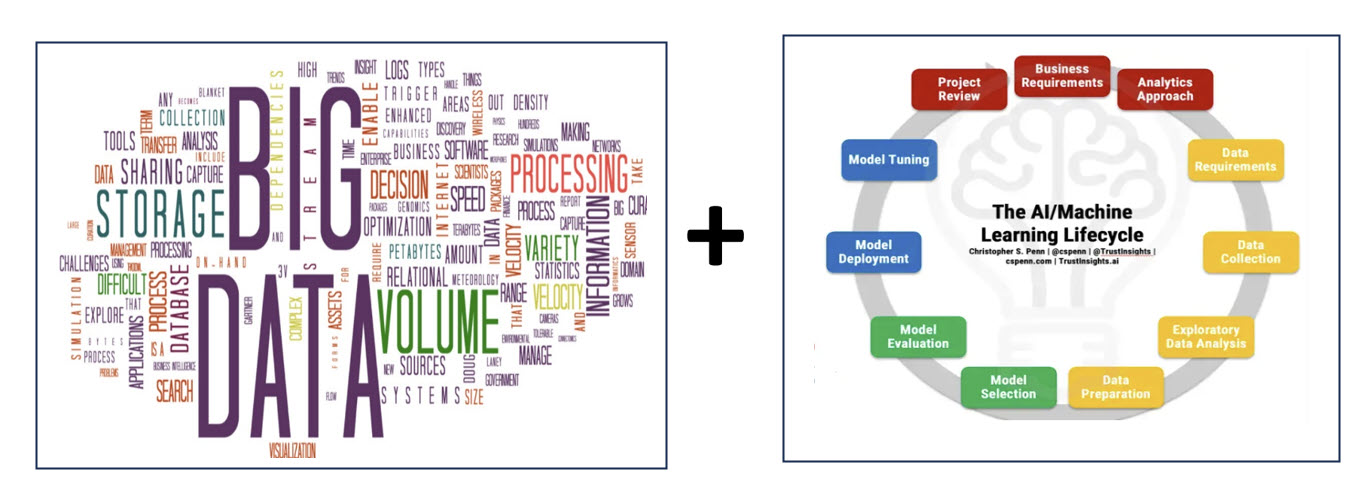
Big Data + AI Project Requirement Image Project Requirement: Project requirements are important because they inform and guide the motivation and direction of your entire project. Project requirements dictate the specific methodology, timelines, and resources needed for success. Since no two projects are identical, customizing your approach is crucial to avoid misaligned goals, and wasted effort and time. Understanding the types of requirements and properly categorizing your project ensures a smooth execution. Project Requirement is a Human-Intensive Process: Project Requirement is a human-intensive process and it can also use automation and intelligence support such as the use of ML, templates and AI chatbots. The automation of the project requirement is very limited due the fact that the project's details, clients, users, data and goals-scope may not have been developed in the past and it has no record or tracking. Therefore, the need for Human Talent, AI and IT experts and Business Analysts are critical in this Requirement Stage. Big Data: Big Data adds a great value to system development, data processes and the running AI agent. Therefore, With Big Data Search Components Documents is our attempt to find what items and search criteria are needed for searching and analyzing Bid Data. In this stage, we can use automation (templates banks), ML engines and AI processes (Added Intelligence Engines) and AI Chatbots. Developing Project Roadmap Using Big Data and Project Requirement: A Project AI Automation and Intelligence Roadmap is the sequence of processes of deployment of artificial intelligence to optimize, visualize, and automate complex workflows. It pairs AI automation with intelligence processes (Machine Learning, Bid Data and AI Chatbots) to automate the development of an AI system. Note: Our audience need to understand that project's requirement and Big Data search must be done first before we can start any of our automated roadmap. In short, this requirement document must be done first and developing this requirement documentation can have the following options: 1. Human - analysts - must 2. Using automation (templates banks) 3. ML engines 4. AI processes (Added Intelligence Engines) 5. AI Chatbots For Our Project AI Automation and Intelligence Roadmap documentations – see the following links: https://sameldin.com/AI_VirtualButlerProjectFolder/AI_VirtualButlerProjectStartPage.html https://sameldin.com/ButlerTechnicalReviewAnswersFolder/TechnicalReviewAnalysisDevelopmentTwinTestingDeployment.html https://sameldin.com/VAITMINS_AnalysisArchitectFolder/VAITMINS_AnalysisArchitectPage.html Define Budget and Timeline: Would be provided soon. Functional Requirements What are functional requirements? A functional requirement is a statement of what the system, subsystem, system component, device or software program must perform. The following are Functional Requirement Features: 1. User authentication and authorization 2. Data input methods (text, image, audio, video) 3. AI prediction/generation capabilities 4. User interface for interacting with the AI 5. Result visualization and reporting 6. Feedback collection from users 7. Logging and audit trails User authentication and authorization: The security section will cover all the details and the security structure. Data Input Methods (text, image, audio, video): Our AI Virtual Butler would be running on PCs, mobiles and tablets or any electronic device. It would be cloud-based and provides all cloud security, compliance, performance, availability and intuitive and easy to use by elders. At its core, it blends automation, organization, and conversational intelligence to assist with matters such as: • Scheduling and calendar management • Sending messages or coordinating communications • Retrieving information or preparing summaries • Managing reminders, tasks, and daily logistics In short: An AI Virtual Butler is a personal assistant with a memory, a mind for efficiency, and-if properly designed-a touch of charm. AI Prediction/Generation Capabilities: AI prediction and generation capabilities define what a system can accomplish by parsing data to either forecast future events or output novel content. Together, these functionalities automate complex workflows-from business decision-making to software requirement drafting—by shifting computing from simple execution to active problem-solving and creation. Our AI Tailored Virtual Butler Project is one of the answers in helping the elderly with cognitive challenges. In short, our AI Tailored Virtual Butler would be helping elderly with every day task including elders' finances, physical security and physical training. Our AI Tailored Virtual Butler Project would be the AI-powered cognitive support system that acts as a real-time memory, decision assistant, and daily guide for older adults-while keeping caregivers in the loop. We are using our ML tools (engines) plus AI chatbots to parse and convert Big Data into our manageable Data Matrices. Our ML engines are the core power in the Big Data parsing and conversions and AI chatbots are supporting search tools. We do need to use AI chatbots such ChatGPT or any AI chatbots for value matching and errors correction. AI chatbots: These AI chatbots have very impressive text and graphic analysis which we are harnessing their power. Our main power when it comes to developing any AI system is our Machine Learning Engines and "not AI chatbots." These AI chatbots are very handy when it comes text and graphics. Therefore, we use These AI Search Tools when in comes to image analysis, voice-to-text messages or any text-image messages comparisons. Note: It is easier, convenient and cost effective to use these AI chatbots instead of building them. Developing them would be costly effort which would require tremendous efforts, time and testing. Therefore, AI chatbots is a fare better choice than developing these AI chatbots. User Interface for Interacting with the AI: A User Interface (UI) in AI refers to the medium through which humans interact with artificial intelligence systems. It translates complex AI models into accessible formats like text, voice, or visuals, allowing users to input prompts, receive responses, and navigate features. Our AI Tailored Virtual Butler interface is not a User Interface support by AI nor Generative User Interfaces (GenUI). Our AI Tailored Virtual Butler interface(s) with our ML and AI processes supporting an elder whom we have all the elder data we need to communicate and address the elder's needs. See our Core Support section. Result Visualization and Reporting: Result Visualization and Reporting AI are an intelligent technology that automatically aggregates, analyzes, and translates raw data into visual formats like charts and narrative reports. It uses machine learning to spot hidden patterns, suggest the best visual layouts, and generate plain-English insights, eliminating manual number-crunching. Core Components are: • Automated Data Processing • Intelligent Charting • Natural Language Generation (NLG) • Natural Language Querying (NLQ) Key Benefits: • Democratization • Speed • Proactive Intelligence Our system is architected-designed to handle all the above feature, plus we would be using AI Search Tools when it comes to image analysis, voice-to-text messages or any text-image messages comparisons. Feedback Collection from Users: Collecting user feedback involves a mix of direct input (surveys, interviews), indirect signals (support tickets, reviews), and inferred data (analytics, session replays). To maximize response rates and gather high-quality insights, always time your requests carefully, keep forms concise, and offer incentives. Our AI Tailored Virtual Butler services are running 20X7 servicing elders with constant communication with family members, caregivers and system tracking. Our system is AI based with ML, where our ML is continuously learning from the system performance and data generated. Our system is also using our Virtual AI Twin Management International Network System (VAITMINS) which is the analysis-architect-design for the automation of the Software Development Lifecycle, DevOps and Management and Tracking System. We recommend that our audience check our Virtual AI Twin Management International Network System (VAITMINS) Page. Logging and Audit Trails: See the pages on ML, History, Audit Trail and logging. Non-Functional Requirements (NFRs): Non-functional requirements (NFRs) define how a system should behave and operate, rather than what it should do. While functional requirements cover specific features for example credit cards processing. NFRs define the system's overall quality attributes, performance standards, security protocols, and operational constraints. System Qualities: Security, Compliance, Performance, Availability, ... etc. Our AI Virtual Butler would be running on PCs, mobiles and tablets or any electronic device. It would be cloud-based and provides all cloud security, compliance, performance, availability and intuitive and easy to use by elders. Data Requirements AI data requirements focus on data plus demand that data should be: 1. High-quality 2. Scalable 3. Data accuracy 4. Properly structured 5. Continuously governed (administered) 6. Protect Privacy Our project goal of data requirement is to access Big Data and capture the “Five Vs” of Big Data (Volume, Velocity, Variety, Veracity, Value). We are using our ML tools (Engines) plus AI Chatbots to parse and convert Big Data into our manageable Data Matrices. Again, our audience need to check our webpages and our Virtual AI Twin Management International Network System (VAITMINS). Data Core Support: An AI data core support definition involves the technical systems, architectures, and IT services required to store, manage, and process data so that Artificial Intelligence and Machine Learning (AI/ML) models can train, scale, and function accurately. Data Core Support must address the elderly needs: 1. Cognitive Support (CORE PRODUCT) 2. Task Execution & Guidance 3. Emotional & Social Support 4. Health & Wellness 5. Financial & Life Management 6. High liability --> should be: 7. Engagement and Growth 8. Personalization Engine - System should learn: 9. Trust & Safety Layer Elderly users are vulnerable to: 10. Liability Section Data Sources and Ownership: AI Data Sources refer to the digital material used to train, test, and fine-tune machine learning models. Data Ownership defines who holds the legal and operational rights to control, access, and profit from this training data, the resulting model parameters, and the AI-generated outputs. Types of AI Data Sources: • Public Scraped Data • Proprietary/Licensed Content • User Input Data • Synthetic Data Types of AI Data Sources for Elderly: AI data sources for elderly individuals are primarily categorized into: 1. Biometric monitoring 2. In-home environmental sensors 3. Conversational interactions 4. Clinical/administrative records 5. Clinical & Health Records 6. Patient-Reported & Digital Interaction These inputs feed machine learning models to support aging-in-place, manage chronic conditions, and detect emergencies. Ownership of Elderly Data Sources: The term ownership of elderly data sources typically refers to: • Control • Rights • Responsibilities associated with information collected from or about older adults. Depending on the context, ownership can mean: • Who owns the physical data records • Who governs the data • Who owns the facility/platform collecting the information Because this topic touches on sensitive health and demographic information, the landscape is divided into three primary domains of ownership and control: 1. Patient Health Records and Wearables 2. Longitudinal Studies and Research Registries 3. Institutional Care Data (Nursing Homes and Hospitals) Federal and Private Data Sources: 4. Federal Tracking: The Centers for Medicare & Medicaid Services (CMS) 5. Private Equity and Chains 6. Centers for Medicare & Medicaid Services (CMS) Provider Data Catalog 7. Medical records or research data repositories 8. Corporate ownership of a specific nursing home 9. Privacy rules of consumer health devices Data Collection Procedures: AI data collection procedures are the standardized methods and pipelines used to gather, clean, and format raw information to train, fine-tune, or ground artificial intelligence models. These procedures ensure that the ingested data is accurate, unbiased, properly labeled, and compliant with privacy regulations before model training begins. Core Data Collection Procedures are: 1. Goal Identification & Data Specification 2. Data Sourcing & Gathering 2.1 Web Scraping 2.2 APIs 2.3 Human-in-the-Loop (HITL) & Crowdsourcing 3. Preprocessing & Cleaning 3.1 Normalization 3.2 Deduplication 3.3 Handling Missing Values 4. Annotation and Labeling 5. Data Management, Packaging, and Versioning 6. Synthetic Data & RLHF Data Quality Standards: AI data quality standards refer to the criteria and methodologies ensuring data is accurate, unbiased, and fit to train or operate machine learning models. Unlike traditional data, AI standards require strict attention to data representativeness, annotation accuracy, and continuous monitoring to prevent model drift and systematic bias Is there an ISO Standard for AI? The portfolio includes: • ISO/IEC 42001 (a certifiable management system for AI) • ISO/IEC 23894 (risk management) • ISO/IEC 22989 (concepts and terminology) Use 42001 to govern and audit your AI program, and the other standards to shape lifecycle, risk and quality. Core Evaluation of AI Data Quality: To ensure AI models generalize effectively rather than hallucinating or producing skewed outputs, data must be evaluated across these critical pillars: • Representativeness • Accuracy • Completeness • Consistency • Timeliness Global and Industry Standards: As AI adoption has matured, governing bodies have established formal standards to help enterprises operationalize data governance: • ISO/IEC 5259 Family • ISO/IEC 42001 • NIST Guidelines Best Practices: Relying on manual, point-in-time data cleaning is no longer viable. Leading teams implement the following strategies to guarantee AI data integrity: • AI Observability • Automated Data Validation • Rigorous Traceability AI data Quality Testing: AI data quality testing is the systematic process of validating and evaluating datasets to ensure they are: 1. Accurate 2. Complete 3, Unbiased 4. Fit to train or operate machine learning models 5. It measures variables like representativeness 6. Label accuracy 7. Systemic bias alongside traditional metrics How AI Transforms Data Quality Checks: Artificial intelligence enhances data quality in three primary ways: 1. Anomaly Detection 2. Agentic AI & Natural Language Generation 3. Unstructured Data Parsing Data Labeling/Annotation Requirements: Data labeling and annotation transform raw data (images, text, audio) into structured datasets to train AI models. This involves attaching specific tags to broad categories (labeling) or marking detailed metadata (annotation). Data labeling and annotation requirements involve: 1. Establishing clear guidelines 2. Defining precise schemas 3. Ensuring rigorous quality control Sadly, our AI approach does involve any data training nor labeling. Therefore, we do need to go further than our approach statement. Data Storage and Retention Policies: An AI data retention policy defines how long raw training data, model inputs, conversation logs, and outputs are stored. Balancing data availability against privacy requires clear retention periods, automated deletion, and risk mitigation. Implementing these frameworks ensures compliance with privacy regulations like the GDPR and the EU AI Act. We have architected-designed our DevOps for AI Model-Agents system and our audience can refer to our: https://SamEldin.com https://gdprarchitects.com/ For more details. Data Privacy and Compliance Requirements: AI data privacy and compliance require embedding privacy-by-design, security, and transparency into every phase of AI systems. Organizations must govern data handling - from model training to output generation - to satisfy sweeping regulations like the EU AI Act and state privacy laws. AI data privacy and compliance require embedding privacy-by-design, security, and transparency into every phase of AI systems. Organizations must govern data handling - from model training to output generation - to satisfy sweeping regulations like the EU AI Act and state privacy laws. At this point in time, we are in the architecting and design phase plus our partners and investors must be in the loop. We will be proving all the coverage of AI data privacy and compliance requirement. Training, Validation, and Test Datasets: In machine learning, splitting data into training, validation, and test datasets is the foundational workflow used to build models that can generalize to new, unseen information. Properly partitioning your data ensures you do not accidentally create a model that simply memorizes the training data - a critical flaw known as overfitting. Again, our architect-design has all our validation and testing, and Training does not apply to our system. AI/ML Requirements AI and Machine Learning (ML) requirements span foundational math, programming, and system design. Breaking into the field typically requires Python proficiency, experience with ML libraries like PyTorch and TensorFlow, and a solid understanding of linear algebra, calculus, and statistics. The AI/ML Requirements processes: 1. Choice of AI approach (machine learning, deep learning, generative AI, etc.) 2. Model training pipeline 3. Feature engineering process 4. Hyperparameter tuning. • Model evaluation metrics: 4.1 Accuracy 4.2 Precision 4.3Recall 4.4 F1 Score 4.5 ROC-AUC 4.6 BLEU/ROUGE (for NLP) 5. Explainability requirements. 6. Bias and fairness assessment. Our AI system is quite different and we will be covering these sections in our ML engines and Added Intelligence engines sections. Technical Requirements Technical requirements are the specific technical criteria, constraints, and conditions a product, system, or project must meet to function effectively. While business requirements define what a project needs to do, technical requirements define how it is built, maintained, and operated. Technical requirements outline how a system or product will be built. While business requirements define the "what" (objectives and end-user needs), technical specs translate those into actionable development constraints, including hardware, software architecture, security, performance, and scalability. Defining these requirements ensures that project goals align with technical feasibility and helps avoid costly rework later in the development lifecycle. The following is a list of technical requirements: 1. Programming languages 2. Frameworks and libraries 3. Database requirements 4. API integration requirements 5. Cloud infrastructure requirements 6. Graphics Processing Unit (GPU)/compute requirements The following webpages covers all our technical requirement for Virtual Butler Project: https://sameldin.com/AI_VirtualButlerProjectFolder/AI_VirtualButlerProjectStartPage.html https://sameldin.com/ButlerTechnicalReviewAnswersFolder/TechnicalReviewAnalysisDevelopmentTwinTestingDeployment.html https://sameldin.com/VAITMINS_AnalysisArchitectFolder/VAITMINS_AnalysisArchitectPage.html https://sameldin.com/AI_Folder/SwitchCaseAl_Model_AgentPage.html DevOps - Infrastructure Support AI Machine Learning Operations (MLOps) AI Business Plan Videos' Scripts - AI Data Centers Our AI DevOps System: 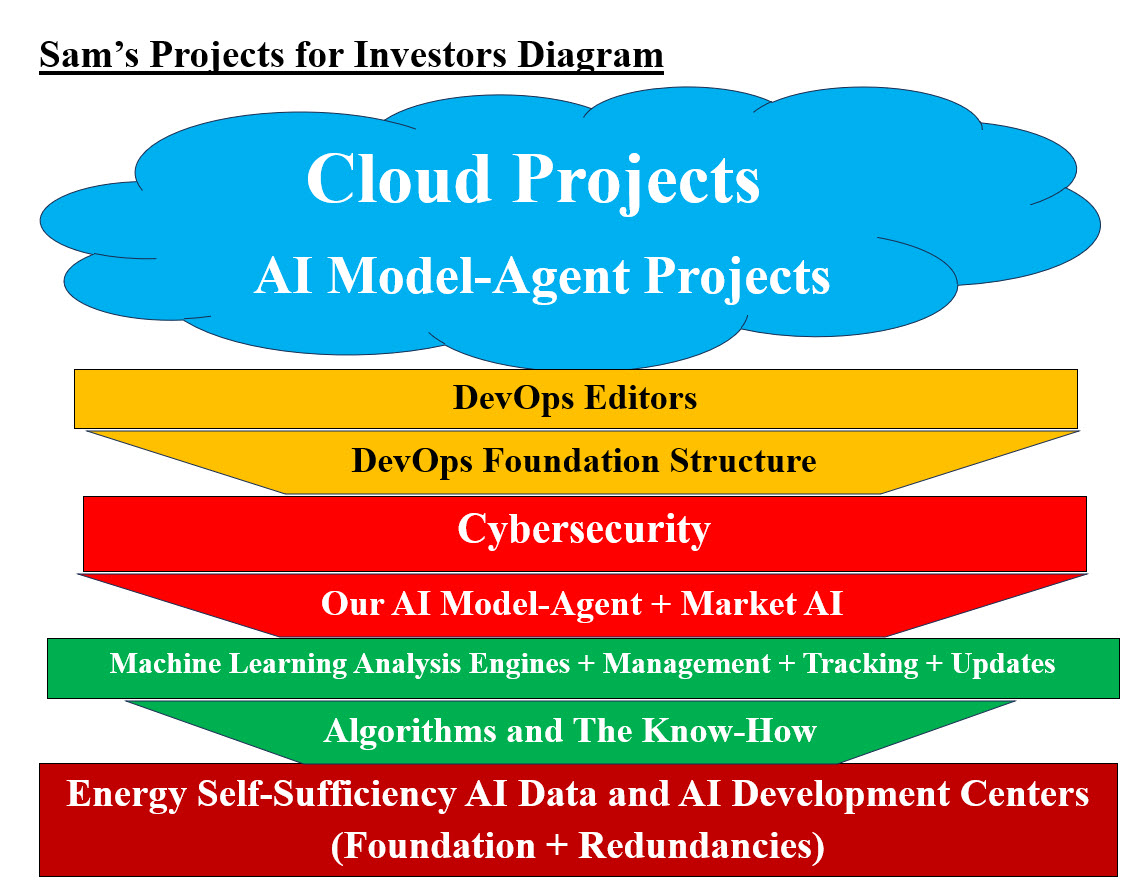
Our 2,000 Foot View of Our Artificial Intelligence (AI) Tools and Projects See Sam's Investors Presentation Script Page Our Artificial Intelligence (AI) Tools and Projects covers the following topics: • Security Requirements • Performance Requirements • Deployment Requirements • Testing Requirements • Monitoring & Maintenance • Production |
|---|