
|
Sam Eldin's AI Tailored Virtual Butler Project©
Our Answers to Technical Review |
|---|
|
Our Answers to Technical Review Table of Contents: • Introduction • Technical Review • Executive Summary • Our Turn to Answer • Who we are or who is Sam Eldin • Website Pages for the Knowledge Base • Difference between us and what is in the AI market • Our Answers • #1. Buzzword density without definitions • #2. The "Big Data -> Values Tables -> Long Integer Matrices" pipeline is technically broken ... • #3. The AI/ML project lifecycle is incomplete and partially inverted • #4. "Testing is a carbon-copy of Development" is incorrect • #5. Multi-agent system claims are unsupported • #6. "Development becomes fill-in-the-blank" is wishful • #7. The deployment admission contradicts the value proposition • #8. "Minimize human-in-the-loop" is presented as a feature; it is a risk • #9. Documentation quality • #10. Proprietary methodology with no external grounding • What Would Have to Change for This to Become Credible • Feasibility Verdict • Additional Critics Comments • Our Answer to Additional Critics Comments and Caution Introduction: This page is our answers to GitHub's Technical Review. We also posted GitHub's Executive Summary as a quick introduction and we posted the entire doc as a PDF page link following the executive summary. According to GitHub's Technical Review doc, they listed the following topics which we will be addressing each one: 1. Buzzword density without definitions 2. The document repeatedly invokes the same four-item toolkit at almost every stage: a. "ML Engines" b. "AI Added Intelligence Engines" c. "AI chatbots" d. "Templates Banks" 3. The "Big Data -> Values Tables -> Long Integer Matrices" pipeline is technically broken 4. The AI/ML project lifecycle is incomplete and partially inverted 5. "Testing is a Twin of Development" is incorrect 6. Multi-agent system claims are unsupported 7. "Development becomes fill-in-the-blanks" is wishful 8. The deployment admission contradicts the value proposition 9. "Minimize-human-in-the-loop" is presented as a feature; it is a risk 10. Documentation quality 11. Proprietary methodology with no external grounding 12. What Would Have to Change for This to Become Credible 13. Feasibility Verdict We will start our answers by covering a number of concepts which are also part of our answers. Technical Review: AI Automation and Intelligence Project Roadmap Reviewer: Independent technical review (AI/ML) Executive Summary The proposal reads as a high-level conceptual narrative built around proprietary terminology rather than an executable technical roadmap. It strings together buzzwords ("ML Engines," "Added Intelligence Engines," "AI chatbots," "Templates Banks," "Long Integer Matrices," "Traversing Trees") that are either non-standard or used in ways that depart from their accepted technical meaning. None are defined in implementation terms. Several core design ideas - most notably the claim that Big Data can be accessed once, distilled into "Values Tables," then converted to "Long Integer Matrices" for all downstream use - reflect a misunderstanding of how data, features, and model training actually work in modern AI/ML systems. The proposal also contains structural gaps that are disqualifying for any serious project plan: no evaluation methodology, no metrics, no data labeling/ground truth strategy, no compute or cost estimate, no timeline, no team composition, no risk treatment, and an explicit admission that the team cannot deliver the deployment stage. My recommendation is at the bottom of this document. The short version: not feasible as written. Technical Review - AI Automation and Intelligence Project Roadmap Our Turn to Answer First, we would to thank all the involved parties for all the efforts and time and we do appreciate their critics and all the corrections and comments. Standard Research Disclaimer: Some of the definitions provided in our documents are based on internet research (including AI websites) conducted in Year 2026. While we strive to ensure the accuracy and reliability of the data, it is provided "as is" without warranties of any kind. This information is for general informational purposes only and should not be treated as professional advice. Users should independently verify any facts, figures, or conclusions before making decisions based on this research. Note: We are presenting concepts definitions with definitions stated on the internet (what the world views) and we also present our own definitions and approaches. We are not using any of the AI vendors tools or approaches nor we believe we need any, since we believe our approaches and tools are the future of the current AI systems and tools. In short, we are presenting some of definitions in our webpages according to internet searches to keep our presentation update. Our Goal: Our goal is to address all the Critical Findings with proper answers. To present all the answers in one page would difficult, but we are presenting these answers over several webpages. We need to make our audience aware that what we are presenting is very technical and the readers have to have the basic knowledge of IT and AI. Therefore, we need to have a strategy in our presentation. Our strategy is: • Quick presentation of who we are • The difference between our AI approaches and current AI vendors tools and approaches • Links to all our webpages “Knowledge Base” and LinkedIn articles • We are answering the Critical Findings using our documentations for a number of projects Our audience are free to make their judgement on our AI approaches and tools. Who we are or who is Sam Eldin: In short, Sam Eldin is a former professor of Computer Science and sole owner of ZebraSoft.com, CRM Data Farm (CRMDataFarm.com) and latest (coming soon) Automated Architects-Designs and Data Centers for AI (AADDforAI.com). We believe we are ahead of our time and the world of AI + IT are playing catchup, but we did not get our change in the spotlight yet. We can only say, our turn or time has not come yet. For example, our Business Program system which we invented over 20 years ago, is what is known today as Machine Learning. Again, for AI system, we have been architecting-designing what we called Intelligence system. The webpages and LinkedIn articles in the next section may shed some lights on our claims. My CV-Resume to the World - SamEldin.com Website Pages for the Knowledge Base: ____________ Documented Pages _________________ 1. Technical Review-Analysis-Development-Twin Testing-Deployment 2. AI Virtual Butler Project Requirement 3. AI Virtual Butler Project Architect-Design 4. VAITMINS Analysis and Architect 5. Machine Learning 6. Artificial Intelligence (AI) 7. AI Business Plan 8. Our AI Virtual Receptionist Systems (Model-Agent) 9. AI Business Plan Videos' Scripts 10. Sam's Investors Presentation Script Introduction YouTube Video ____________ LinkedIn Articles _________________ L1. Global Network of AI Data and Development Centers https://www.linkedin.com/pulse/global-network-ai-data-development-centers-sam-eldin-kbf4f L2. Sam Eldin's Business Plan for Energy Self-Sufficiency AI Data and AI Development Centers https://www.linkedin.com/pulse/sam-eldins-business-plan-energy-self-sufficiency-ai-data-sam-eldin-ftzxf L3. Sam Eldin's Switch-Case Algorithm https://www.linkedin.com/pulse/sam-eldins-switch-case-algorithm-sam-eldin-sbn8f L4. Sam Eldin’s Switch-Case AI Model-Agent (Our AI Virtual Receptionist Systems) https://www.linkedin.com/pulse/sam-eldins-switch-case-ai-model-agent-our-virtual-systems-sam-eldin-dp9sf L5. Sam's Machine Learning https://www.linkedin.com/pulse/sams-machine-learning-sam-eldin-do6jf Difference between us and what is in the AI market: To be blunt, our approaches and our tools of AI systems are totally different than what is running in the market today. We believe our AI approach is the true intelligence and not photographic memory systems where AI system learns through labeling and endless search patterns. According to an internet search, a person with a photographic memory is not necessarily intelligent because memory recall and general intelligence rely on completely different cognitive systems 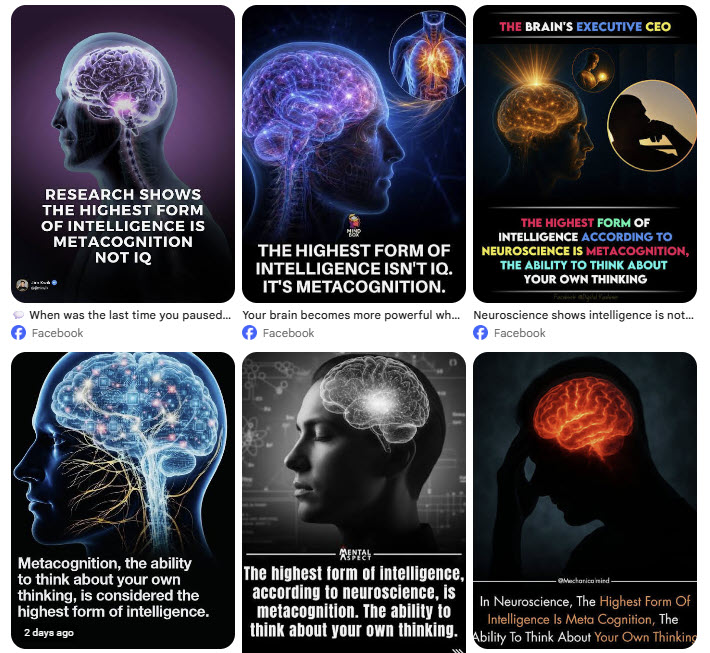
Image #1 Intelligence and Photographic Memory Today, AI systems are very impressive when it comes to Text and Graphics which they both are math (a lot very fast-expensive processors which are running behind the scene). Their performance is amazing, but sadly it is not true intelligence. For example, a person with a photographic memory where he would memorize all the questions, answers, ... etc., may sound like he knows everything and impress anyone with quick and accurate answers, but such a person may not have true intelligence. To test such a person, you need to take him out of his confront-zone and watch him sweet in finding answers. Everyone who is using Chatbots knows that, once your request is out of their confront-zone, then you would get a very impressive message that does not answer your question. Plus, these Chatbots would agree with everything you presented. Our audience need to checkout our intelligence approaches in our websites and see for themselves true approaches to intelligence. Our Answers We do recommend that our audience needs to go and check the link in the Executive Summary section and see for themselves the questions and comments. In this page, we will present a quick and short answer, and list the links for the pages which would have more details and complete answers. Note: Most of Critical Findings seemed to be based on the lack of basic knowledge of our new AI approaches. It also seemed that no one was willing to check our websites nor ask us for clarification of our Roadmap details. #1. Buzzword density without definitions We need to remind our critics and our audience that we are not following the main stream "industry-standard terms." We are very much started new way of thinking and its vocabulary can be found in our webpages starting with Technical Review, Analysis. Development, Twin Testing and Deployment Page - under Redefining Intelligence or AI as a Tool. The only note that we called AI Chatbot with the name of "AI Search Tools" which we believe they are search tools. Plus, in the case we would need their services, to us they are search tools. As for: " 'Added Intelligence Engines' - in particular has no accepted meaning," Google to the rescue: A software engine is a core component or underlying subsystem of an application that performs the central processing, logic, or heavy lifting "under the hood." Like a car engine powers a vehicle, a software engine takes in data inputs, processes them through core algorithms, and delivers specific outputs without requiring direct interaction from the user. Sadly, our Intelligence approach is performed by Software Engines or Engines. These intelligence engines are added to models as needed. This makes our AI systems dynamic and it has the ability to grow or handle more intelligence tasks. We call them "Added Intelligence Engines" as the name implies, they are added to the target AI system. Template Banks: I am not sure what to say here, but Google may answer for us: "a centralized repository, library, or collection of pre-configured, reusable templates within a software system" #2. The "Big Data -> Values Tables -> Long Integer Matrices" pipeline is technically broken ... We cannot answer this question nor comment on it. The answer would be found in all our webpages. These are our trade-secrets and also the power of our system. We are presenting our trade-secrets here since we already had copyrighted them and we hope no-one would use them without our written permission. "Hopefully error-free" is not an engineering plan We cannot disagree with the statement nor correcting the critic. As IT architect-designer-analyst-programmer-manager, I personally would say that: Have-to-Have and Nice-to-Have is part of software engineering plan, and with the same logic and we can state that: Error-Free and Hopefully-Error-Free In any both cases or statements, we are planning for worst case scenario and at the same time, we are hopeful that it would not take place. #3. The AI/ML project lifecycle is incomplete and partially inverted Our only answer to such statement is the we are not using any of the current AI market technologies nor need any of it. We definitely can use AI Chatbot as a AI Search Tool in some of architect-design. These chatbots have very impressive text and graphic analysis which we would be harnessing their power. Our main power when it comes to developing any AI system is our Machine Learning Engines and "not AI Chatbot." These AI chatbots are very handy when it comes text and graphics. Therefore, we use These AI Chatbots Tools when it comes to image analysis, voice-to-text messages or any text-image messages comparisons. It is easier, convenient and cost effective to use these AI chatbots instead of building them. Developing them would be costly effort which would require tremendous efforts, time and testing. Therefore, AI chatbots is a far better choice than developing these AI chatbots. We are using our ML tools (engines) plus AI chatbots to parse and convert Big Data into our manageable Data Matrices.Our ML engines are the core power in the Big Data parsing and conversions and AI chatbots are supporting search tools. We do need to use AI chatbots such ChatGPT or any AI chatbots for value matching and errors correction. 4. "Testing is a carbon-copy of Development" is incorrect We need to admit that we used the wrong words and we are here to correct such statement. We would replace: Testing is a carbon-copy of Development With Testing Becomes a Twin of Development Our Technical Review, Analysis. Development, Twin Testing and Deployment Page has a lot of documentation on the such subject and we would love to hear any critics on such approach. We recommend that our audience check the "Twin Testing" section and see our implementation. The following image is a picture of our architect-design to Development and Twin Testing. 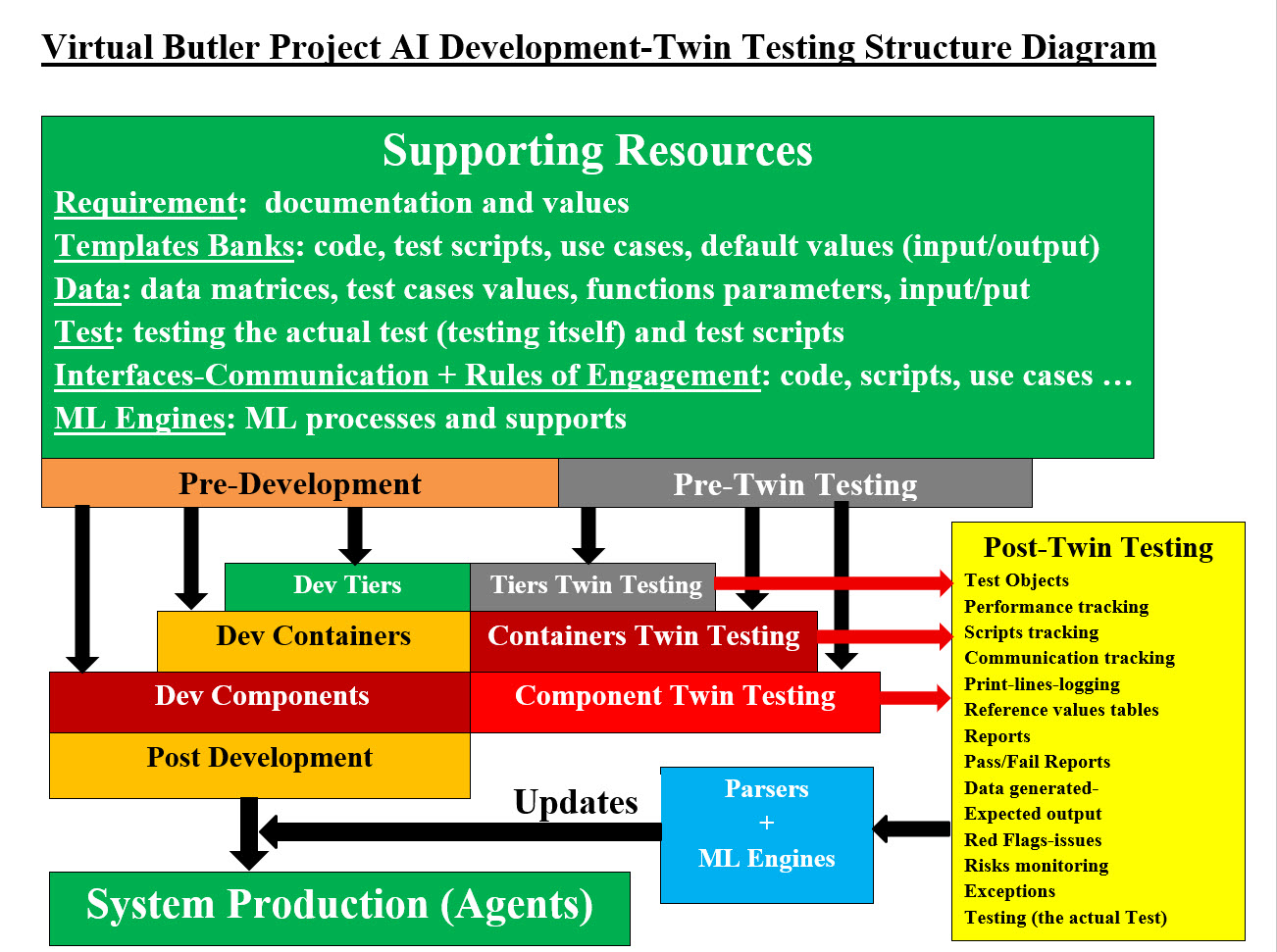
Virtual Butler Project AI Testing Tiers Structure Diagram Image Virtual Butler Project AI Testing Tiers Structure Diagram Image presents a rough picture of both the development and Twin Testing architect-design. Our Architect-Design-Testing Twin Tiers are creating a parallel twin testing architecture. We can test each layer independently and continuously. The same thing would apply to containers, components and their respective Twin Testing. #5. Multi-agent system claims are unsupported We need to remind both critics and our audience that we are not on the same path as the current AI vendors are taking. Our AI systems are based on ML Engines and Added Intelligent Engines as being independent Components. These are components which are added to our AI Models. Afterword, our AI agents (executing software) would be using our AI models based on what does each AI agent need. Therefore, we can have the following: One Model to One Agent - Example Voice to text services Model to a Number of Agent - Example Voice to text services used by many Agents A Number Models to Agent - Example, Voice to text services and Graphic to help in a parsing Agent The power of Models and Agents scalability is provided by our ML engines and Added Intelligent Engines. Our AI Model and Agent Architect-Design Traversing Tree would be the perfect tool for building any a number of Models and any number of Agents. #6. "Development becomes fill-in-the-blank" is wishful We need to remind both critics and our audience that we are not on the same path as current AI vendors are taking. Our Technical Review, Analysis. Development, Twin Testing and Deployment Page has a lot of documentation on the such subject and we would love to hear any critics on such approach. #7. The deployment admission contradicts the value proposition Sadly, we do not have an answer for #7. #8. "Minimize human-in-the-loop" is presented as a feature; it is a risk We ask our Google friend this question and the reply is: Minimizing the "human-in-the-loop" is a core objective for driving efficiency and scale, but the ultimate goal is optimizing human-machine collaboration, not necessarily eliminating people. While automation aims to free humans from repetitive tasks, total removal is rarely the target in high-stakes fields. We would like to mention that in our Requirement Page stated the following: Project Requirement is a Human-Intensive Process: Project Requirement is a human-intensive process and it can also use automation and intelligence support such as the use of ML, templates and AI chatbots. The automation of the project requirement is very limited due the fact that the project's details, clients, users, data and goals-scope may not have been developed in the past and it has no record or tracking. Therefore, the need for Human Talent, AI and IT experts and Business Analysts are critical in this Requirement Stage. Developing Project Roadmap Using Big Data and Project Requirement: A Project AI Automation and Intelligence Roadmap is the sequence of processes of deployment of artificial intelligence to optimize, visualize, and automate complex workflows. It pairs AI automation with intelligence processes (Machine Learning, Bid Data and AI Chatbots) to automate the development of an AI system. Note: Our audience need to understand that project's requirement and Big Data search must be done first before we can start any of our automated roadmap. In short, this requirement document must be done first and developing this requirement documentation can have the following options: 1. Human - analysts - must 2. Using automation (templates banks) 3. ML engines 4. AI processes (Added Intelligence Engines) 5. AI Chatbots #9. Documentation quality We do ask for forgiveness and our only execute is that Sam I am is a one-man-show and resources are almost zero. We are architecting-designing the future system of AI and IT and there is a lot more critics than helpers including my family. This time we did not use the word "Hopefully" in our answer. #10. Proprietary methodology with no external grounding Our critics are very deeply dependent on vendors and vendors supports and we see that as weakness and not strength. We need to remind both critics and our audience that we are not on the same path as the current AI vendors are taking. Therefore, we recommend that our critics invest in learning our approaches, our vocabulary and tools and (again the word) "Hopefully" may have a return on their investment. What Would Have to Change for This to Become Credible First, we do want to thank our critics for their efforts and time. At the same time, we literally have spent a lot of efforts and time trying to present a picture of our different approaches and tools. Communicating using the same language and terms are critical for all parties to be on the same page. "Standard practice is to ground a proposal in named frameworks (MLflow, Kubeflow, LangGraph, AutoGen, CrewAI, MLOps maturity models, NIST AI RMF, etc.) and explain where the proposed approach diverges." We see that AI and IT worlds are very entangled with vendors approaches and supports. Another issue is that everyone is singing the same song even if the song is not the best for our technology. Plus, everyone follows the big players blindly and never question if there is a better way. We ask our critics to give us another chance, and look at our approaches and tools and use our webpages links for accessing our presentation-documentation. Our resources are limited and our hosting may not be as secure as people would like to see. FYI: All our webpages are developed using plain-text without any scripts so accessing them is secured. Feasibility Verdict NOT FEASIBLE AS WRITTEN The proposal is a conceptual narrative, not an executable plan. The central data-architecture idea is technically incorrect, the AI/ML lifecycle is incomplete, testing and deployment are under-specified to the point of being non-credible, and the team has stated it cannot deliver the deployment stage. There is no timeline, no budget, no metrics, and no concrete technology stack. Our Answer to Feasibility Verdict: We are presenting our architect-design for the automation of AI Development Lifecycle, DevOps and Management and Tracking and Testing System and not a running system. Additional Critics Comments: If the author can rework the document along the lines in the previous section - concrete tools, real data architecture, an evaluation plan, and a resolution of the deployment gap - it could become a candidate for a small, scoped pilot (one use case, one model, one deployment target, with measurable success criteria) before any commitment to the broader "automate the development of AI systems" vision. I would not approve funding or sign a contract on the current version. One additional caution: The strongest claim in the proposal - that this methodology automates the development of AI systems using AI - is an extraordinary claim. Extraordinary claims require demonstrations, not definitions. Before further investment, ask for a working example of any single stage (most usefully Stage 5 or Stage 6) running on a real problem end-to-end, with outputs you can inspect. Our Answer to Additional Critics Comments and Caution: AI architectural design is the use of artificial intelligence tools to: 1. Create architect-design concepts based on current technologies and target businesses 2. Automate and harness reusability 3. Plan - processes and steps 4. Timeline - based on resources 5. Develop layouts - communication and interfaces 6. Develop the physical structures: tiers-containers-components and testing Again, we are architecting-designing an automated AI system. Due to our limited resources, the size of the projects, the technologies used-needed-supported, we can only do the following: 1. We have invented solid concepts of Intelligence which the current AI vendors cannot even envision 2. We have worked out the mechanics of the tiers-containers-components and testing 3. We presented our plans in high-level so world can them easy - no details otherwise world will get lost 4. We introduce new concepts which does exist today such as Twin Testing, Twin Management, Automated DevOps 5. We are harnessing Templates Power (Banks) of automation and consistencies and reducing development efforts and time 6. Minimizing the "uman-in-the-loop" 7. We have automated Big Data Conversion to Long Integer Records 8. We created images to concepts and structures to make them easy for world to envision our systems 9. Our Projects are Big Projects which need serious players who need to beat the competitions ... etc. see our webpages We are open to answer questions, concerns and we are available for videos-conferences. |
|---|